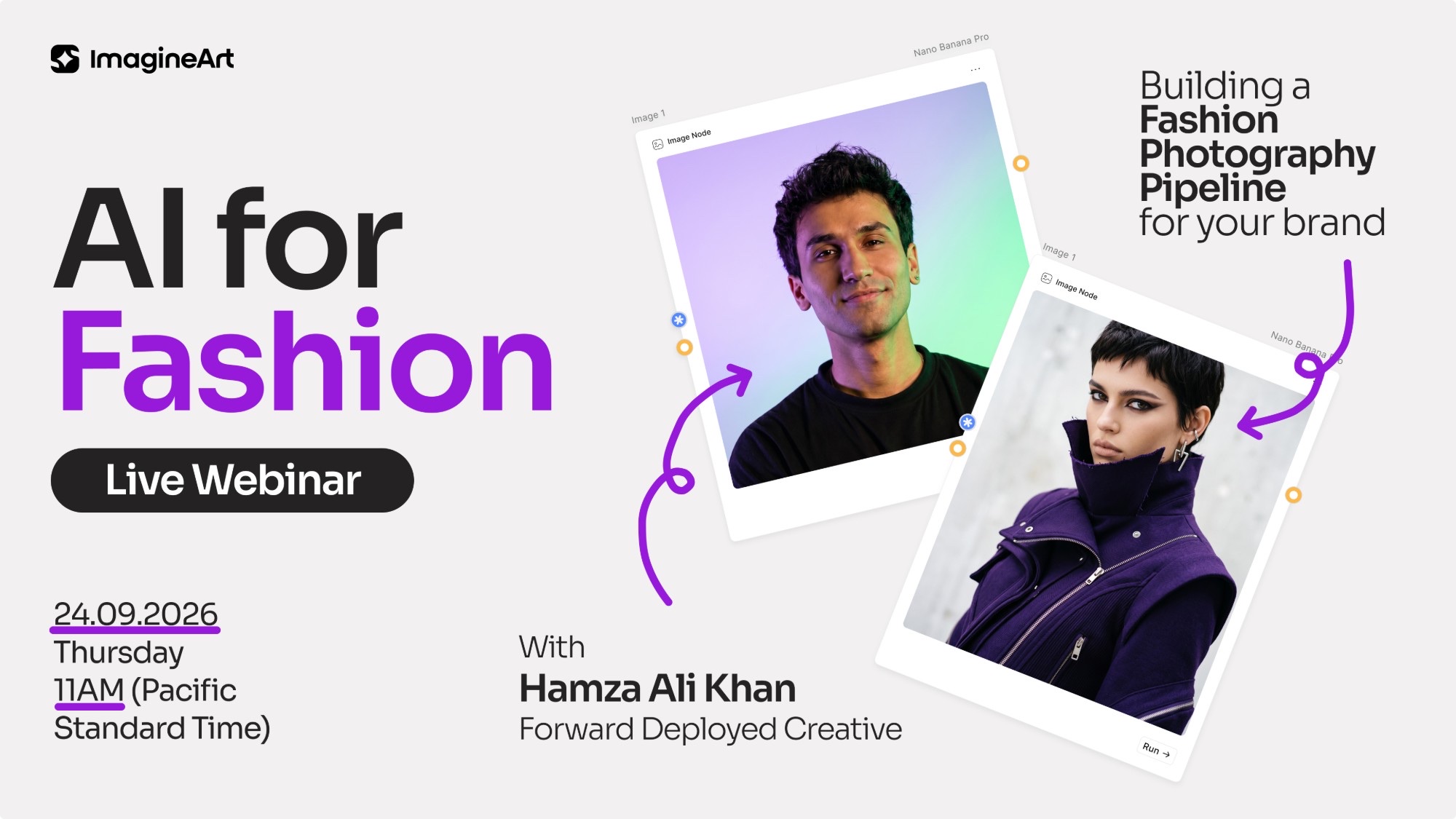
Repeatable AI fashion pipelines start with one accurate garment and one fixed model.
A live build of a fashion photography workflow in ImagineArt, starting from a single flat-lay of a leather jacket and ending with PDP images, editorial concepts and social assets for the same garment.

A flat-lay does not tell a model how a garment falls. Placing it on a torso mannequin first, running several variations and choosing the one closest to the real silhouette gives a single source image that every later output is built from. Photographing the product on a real mannequin is still the better starting point when it is available.
Realistic people come from specific flaws written into the prompt: micro-pores, slight asymmetry, uneven freckles. Asking for a flawless, attractive model produces the plastic look audiences now read as AI. Once a model is chosen it is fixed and reused, so fifty images show the same person.
Keeping the garment and the model in their own upload nodes, with copilot prompts downstream, turns the canvas into a pipeline. Swapping the garment and running again regenerates the full set, from PDP angles to editorial, without rebuilding anything.
The same inputs produce different results across models. In this build GPT Image held the model’s identity but pushed saturation, while Nano Banana kept colour closer to life but drifted more. The LLM behind the copilot changed the styling as well. Each model is a choice of look, not just of quality.
Asking for “a Vogue-style editorial” with nothing else mostly swapped the background. Framing, pose, lighting and reference boards are what change the image. The workflow scales a creative decision; it does not make one.